

This March
In Which You'll Find: Magic, Monomania, Manuals & Manuscripts

March 2026—Spring
A Monthly Note…from Symbolism & Structure
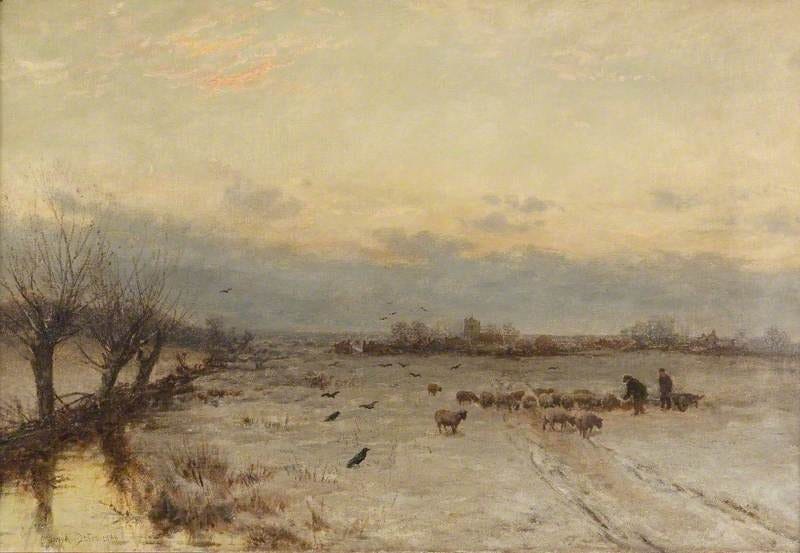
March is one of my favorite months. I am greeted by the raspy caw-caw-cawing of my crows, hinting they have begun to return and will soon choose their nesting sites. The finches also return and begin seeking a nest site in our side yard. In one previous year a house finch couple constructed their cup-shaped nest in the wreath hanging on our front door. Needless to say, ingress and egress proved a bit tricky.
In this third month of the year: Spring arrives (northern hemisphere) and Autumn, too (southern hemisphere). Transition. A threshold. March is magic.
It is March when eighteen-year-old Isabella Linton, picturing Heathcliff, ‘a hero of romance,’ abandons Thrushcross Grange, ‘under a delusion.’ And March, when Nelly Dean delivers Heathcliff’s letter to Catherine. It is Palm Sunday when they bid one another farewell. March—when Cathy Linton is born and Catherine Earnshaw dies.
During the vernal equinox, Heathcliff is provided entry to the drawing room in which Catherine lies. Her coffin remained uncovered and strewn with flowers and scented leaves. And on Good Friday, Catherine is buried.
Before month’s end, Isabella Heathcliff runs away from Wuthering Heights. Years later her son Linton returns. Cathy, Catherine Earnshaw’s daughter, will make his acquaintance. Five years later, ‘there is a strange change approaching.’
All, in this third month of the year. In…March.

I’ve been working on teasing out a ‘golden thread’ I see woven throughout Wuthering Heights. First, I (re)read the novel. I identified passages and jotted down my notes on index cards. Then, I (re)read the novel again…
Using my Indigo Blue Prismacolor pencil, I returned to my Norton 5th and circled each strand of golden thread—sometimes, discovering passages I had overlooked. I found additional passages after I wove A. Stuart Daley’s work into my study.
As I labored I became cognizant of other details—dates, times, ages, seasons—and I collected so many threads of information, everything became tangled. So, toward the end of February, I created a spreadsheet into which I entered all of the chapters and pages and passages so I might begin to see the patterns I am quite certain exist.
Ah, yes. Clarity.
(Re)Visiting: Monomania
I mentioned in my Mid-February note that I was reading Graeme Tytler’s collection of essays, (re)familiarizing myself with this work. I’d especially like to discuss his article, “Monomania: an Anachronism in Wuthering Heights.”1
After sharing my 25 Endearing Heathcliff Moments I learned not unlike the belief there are Jane Austin “girlies” and Brontë “girlies,” there exist Heathcliff lovers and Heathcliff haters.
You know where I stand.
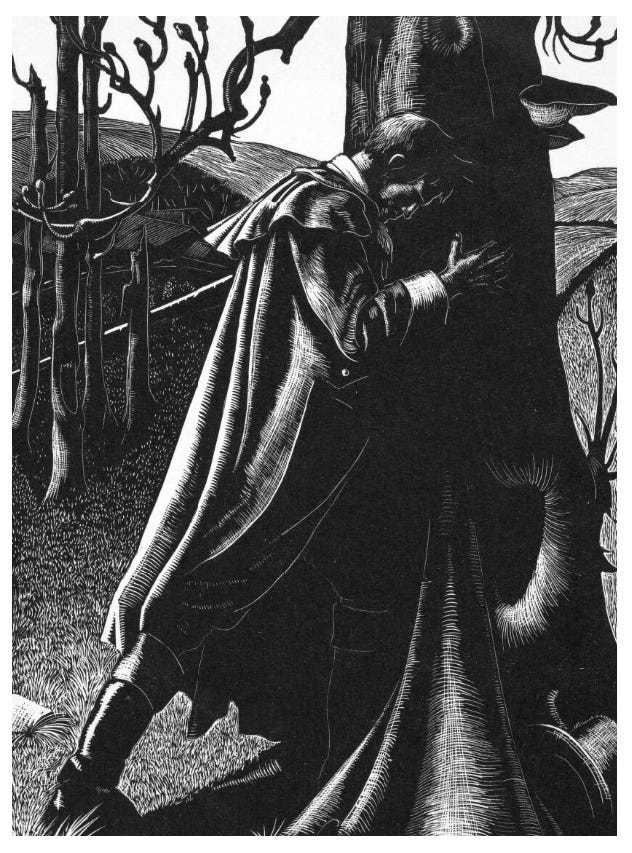
Graeme Tytler wrote the most interesting piece on Emily Jane Brontë’s use of the term monomania to describe Heathcliff and his so-called obsession with Catherine.
I plan to write about it, when I have a moment. Also, I am looking forward to writing about my own (as I’ve often joked) Heathcliff-related monomania. As he is a fictional character, I base my opinion of him solely on Emily Jane Brontë’s presentation of him.
Throughout Fennell February I saw Heathcliff referred to as “a toxic boyfriend.” At no point in the novel is Heathcliff anyone’s boyfriend. If you’ve read Wuthering Heights you know that throughout most of the story, he’s a farmer in his mid-to-late thirties, living with his foster nephew, (briefly, with his posh son) and two servants.
✑ Stop scrolling if you’ve never read Wuthering Heights—abundant spoilers follow…
Heathcliff was for all intents and purposes kidnapped from a street in Liverpool when he was seven-years-old, and removed north to a home in which he was assaulted with a lead weight at age nine and from thirteen onward, he was flogged repeatedly until he fled (on his own accord) from perennial abuse at age sixteen.
No one in the novel deserves love and compassion more than Heathcliff.2
Two people had been kind to him: the man who believed he rescued him (Earnshaw) and that man’s daughter, Catherine Earnshaw. Earnshaw died when Heathcliff was thirteen and the psychological and physical abuse only heightened.
Mr. and Mrs. Earnshaw died natural deaths. Spoiled, bullying Frances (the wife of Hindley Earnshaw) died of tuberculosis, leaving behind her tyrannical and violent, heartbroken husband who dropped their two-year-old from a balcony and drank himself to death.
Sixteen-year-old Catherine Earnshaw forsook her foster brother (and self-proclaimed soul-twin) to align with Edgar Linton’s fortune, after which Catherine spread her own fever (developed while chasing after sixteen-year-old Heathcliff) to aged Mr. and Mrs. Linton, killing them (i.e. orphaning Edgar and Isabella).
Heathcliff returns to the area at age nineteen, intending to kill Hindley (his abuser)...
Immediately upon arriving in Gimmerton, he learns Catherine, now married to Edgar Linton, remains in the neighborhood. Rather than committing murder (and suicide) as he had intended, Heathcliff (ever the opportunist) takes advantage of Isabella Linton’s unsolicited attention. The purpose is twofold: infuriate her brother Edgar and remain in close proximity to Catherine.3
Within months of Heathcliff’s return, Catherine dies. She is only eighteen-years-old.
Isabella abandons him and he couldn’t care less; she was a means to an end. She takes her pregnant belly to the south and Heathcliff carries on peacefully for thirteen years, never harassing Edgar & Cathy Linton or Isabella & Linton Heathcliff.
I am perplexed when I read about Heathcliff’s all-consuming lust for vengeance.
Vengeance would have Heathcliff return and kill Hindley and then, Edgar. He harms neither one4; his loyalty to Catherine prevails. Heathcliff remains submissive, always.
Hindley dies of acute alcoholism and Edgar dies (unmolested) of tuberculosis. In the nearly two decades after the death of Catherine, Heathcliff engages in one single year of so-called vengeance.5 Hardly, a crusade.
If you are Heathcliff-curious, you may enjoy reading some other people’s thoughts—Heathcliff earned an entire volume in the Major Literary Characters series edited and introduced by Harold Bloom.6
A remarkable collection of essays. I highly recommend it. You can find it free HERE.
(Re)acquaintance: Style Manuals & Manuscripts
I created an ORCHID7 in January—to encourage myself to pursue publication. My intention (initially) was to submit a manuscript to The Journal of Dracula Studies but I have a number of research topics in mind for other journals, too.
I’ve not published in a peer-reviewed journal since graduate school; and that research was related to teacher-training and Human Rights Education (HRE). Switching gears to submitting to journals affiliated with the liberal arts and museum studies requires me to step outside my comfort zone—we’re talkin’ a new style guide.
Perhaps you’ve noticed, my footnotes are a sort of chaotic cornucopia of citations? I’m an MLA and APA girl, but I’m becoming comfortable using Chicago Style.
And…I should probably get a handle on my excessive use of italics and erratic, devil-may-care commas. My brazen misuse of the ellipsis may also be a problem.8

When I began writing on Substack, it was a peaceful and encouraging space—Notes had not yet been introduced; video was limited. The halls were a lot less crowded.
I was contentedly writing essays related to my close study of Wuthering Heights…
A handful of readers showed interest in a ‘book club’ and so, I hosted my Spring 2025 read-along. I spent months writing a 9-week book guide and, designing cover images and graphics to accompany my essays and Character guide. In Autumn 2025 I wrote thirty-four essays exploring the Nature and folklore woven throughout the novel.
During my three years here I’ve written lengthy essays about a number of themes in Wuthering Heights and my current project has entirely captivated my attention.
Sadly, in February I repeatedly saw my many hours of research and work shared uncredited across Substack.9 It was both disheartening and blessedly enlightening...

I had been considering sharing my research-in-progress, I have since decided it would be naive to do so. I’ll figure all of it out—but I think I’ll be doing it discreetly, behind a paywall. I never thought I would embrace the paywall. Unfortunately, I’m doing so…
I like to imagine my paywall as a mossy stone structure, with bright green fragile ferns peeking from its cracks. Tiny bits of lichen grow on my paywall, too…and it’s erected in a damp corner of the forest. Near a path.
Essays aplenty will still be scattered all along the path—free for everyone. ♡Tytler, Graeme. 1992. “Heathcliff’s Monomania: An Anachronism in Wuthering Heights.” Brontë Society Transactions 20 (6): 331–43. doi:10.1179/030977692796439621.
Maybe, Isabella.
Honestly though, she endured a few months of neglect whereas Heathcliff was kidnapped, psychologically abused and physically assaulted for three years.
Remember, Catherine intends to provide Isabella with ‘half-a-dozen nephews;’ she is fully invested in her reproductive relationship with Edgar Linton.
Heathcliff kicks the back of Edgar Linton’s chair. And only after an attempt on his life does Heathcliff literally kick (the sh!t out of) Hindley.
Heathcliff induces Cathy Linton to visit her cousin at Wuthering Heights in Autumn 1800 and by Autumn 1801 he compels (chiefly by psychological coercion) the two to marry.
The ‘misery,’ wrought by Heathcliff, spans multiple chapters, and feels like a lifetime, but Heathcliff’s deterioration and mistreatment of Linton and Cathy lasts a single year.
Book jackets and back cover blurbs would have us believe Heathcliff wreaks havoc on the two for decades; while simultaneously their front covers portray the story as a romance.
Bloom, Harold. 1993. Heathcliff. New York: Chelsea House.
ORCID: Open Researcher and Contributor ID
Grammar Police…Go to the Deuce!
During Fennell February Substackers were hosting (unaffiliated-with-me) read-alongs and book clubs and using my original content as their support material. Mind blown.
Happy March and golden threading/spreadsheeting!
I'm so sorry to hear that your incredible work and devotion has been shared uncredited. I'm here for the path and the damp corner of the forest!
These are a few of my favorite things aka yes! yes! to #8 in the cornucopia: "chaotic cornucopia of citations....use of italics and erratic, devil-may-care commas....brazen misuse of the ellipsis."
I just subscribed. I am adamant about not reading spoilers so I’ve been resisting subscribing as I knew I’d want to read all your past postings but now that I’ve finished the book for the first time, I’m ready! I look forward to rereading/reviewing as I agree with you on many points and want to see more closely how the characters are threaded in the story. I was going to see the movie as I was really curious how the heck it was going to be done (again I resisted teasers/trailers/reviews) but just from review headlines I got the gist. So decided to pass. Glad I did. I loved (was amazed) how Catherine’s pregnancy was described in a two line paragraph I had to read three times to get what was happening and she was I forget how many months along and no mention of it. Ok I’m not saying anything you don’t know. Thanks for the comment space and for all your postings. Sorry for the uncredited work, people are unbelievable. Oh and thanks for making your footnotes clickable. That is so helpful to read while reading text. Done now.