

The Twenty-One
Emily Jane Brontë's Poetry

The Complete Poems of Emily Jane Bronte is available on Internet Archive
While working on my current research project I have begun examining Emily Jane’s poetry more closely. Her poetry has become as important to my current close study, as is her masterpiece, Wuthering Heights (but…more on that later).
In Emily Jane Brontë’s lifetime, she published twenty-one poems. Poems by Currer, Ellis, and Acton Bell was published in 1846 and also included poetry written by her sisters, Charlotte and Anne. Only two copies sold in the year after publication.
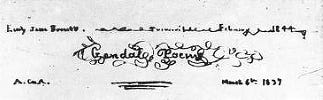
Emily Jane—the name to which I’ll always refer to her (she clearly preferred it, writing it on the title page of her Gondal Poems notebook)—composed her first (extant) dated poem, on 12 July 1836, at the age of 18.1
Curiously, she did not include that first dated poem in her selection for publication. Emily Jane chose 15 poems from her untitled notebook and 6 from the notebook of Gondal Poems.
Are you familiar with the Gondal saga,
written between 1831 and 1848?
Embracing brevity, I’ll assume you are familiar with the poems and continue…
Why am I interested in the Gondal narrative? Characters and concepts conceived by Emily Jane during her seventeen-year project informed Wuthering Heights.
After the death of Philadelphia collector H. H. Bonnell, among his manuscripts, a ‘Gondal Fragment’ was found; on it Emily Jane recorded physical details associated with her characters. Similarly to the way in which Emily Jane describes the ‘dark’ Earnshaws and the ‘fair’ Lintons in Wuthering Heights, she detailed the hair and eye color, ages and complexions of five of her Gondal characters. The diminutive note is made on a 4½ x 3½-inch sheet of paper—a tiny, personal note, written in shorthand.
This Very Private Emily Jane intrigues me most. ♡
‘Wild, Melancholy, and Elevating’
After reading her poetry and novel side-by-side I can’t help but notice similarities between the settings found in the Gondal narrative and Wuthering Heights.
My attention lingers in Emily Jane’s mirror imaginations: reading a description of the home of her childhood hero Sir William Edward Parry (of Parrysland) and comparing it to the household of her oft-criticized anti-hero Heathcliff…
Emily Jane’s invented worlds—first, Parrysland and eventually, the Gondal epic—are a lot like the setting in which we envision Heathcliff—gooseberry bushes, currant trees, ‘dinner, precisely at twelve o’clock.’2 Her poetry beget her prose.
Sadly, Very Private Emily Jane’s world was irreversibly altered
 when her eldest sister Charlotte accidentally discovered
and not-so-accidentally read her poetry.
Charlotte, eldest sister to Branwell, Emily Jane and Anne Brontë, changed the course of Very Private Emily Jane’s life one Autumn day. Charlotte famously confessed:
One day, in the autumn of 1845, I accidentally lighted on a MS. volume of verse in my sister Emily’s handwriting…
I thought them condensed and terse, vigorous and genuine. To my ear, they had also a peculiar music—wild, melancholy, and elevating…3
“How far Emily, uninterrupted, might have carried her verse…no one can say,” said Fannie Ratchford in 1955, “but…the spell was broken by Charlotte’s discovery of her sister’s notebook.”
After hours of raging at her sister, Emily Jane agreed to publish…
The Fifteen
A year before her sister’s discovery, Emily Jane Brontë began transcribing her poems into two separate notebooks. The non-Gondal poems had been written in a notebook now referred to as the Honresfeld manuscript, it includes thirty-one poems.
From it, Emily Jane chose fifteen for publication:
Stars
The Philosopher
Anticipation
Hope
A Day Dream
To Imagination
How Clear She Shines
Sympathy
Plead for Me
Self-Interrogation
Death
Stanzas to--
Stanzas
My Comforter
The Old Stoic
Look at those titles—they beg to be read, don’t they? I wrote about “Stars” only a few weeks ago. I’ll discuss some of the others in future essays—this is meant only to be a brief post…a short survey of the 21 poems Emily Jane personally chose for publication.
The Six
When the Brontë sisters’ collection went to press, it included six additional poems, ninety lines of which have been altered, shifted or omitted to change the nature and their meanings; in other words, she cloaked them!4
Their titles are as follows:
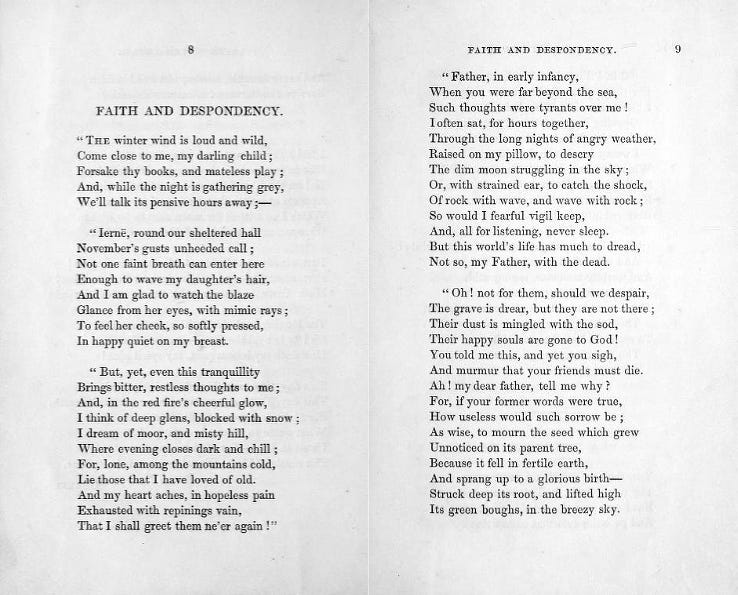
Faith and Despondency
Remembrance
A Death-Scene
Song
The Prisoner (a Fragment)
Honour's Martyr
These poems are found in the notebook labeled Gondal Poems; intriguingly it has been recognized the poems in the untitled notebook exhibit the same subjective material as the poetry transcribed in the titled collection. This is no surprise, as she is the author of both—Only Emily Jane knew her narrative intent.
Not all of Very Private Emily Jane’s secrets have been exposed by Charlotte. ♡
Finally…
Scholarship related to these few manuscripts known to exist is utterly staggering. As I continue to study Emily Jane’s poetry, I will share points-of-interest here and there...
Each day, I scramble down rabbit holes continuously unearthing (new-to-me) details related to Emily Jane’s day-to-day life, her very private writing practice, the evolution of her poetry and I discover hints related to her conception of Wuthering Heights.
I sometimes wonder if there is a point in continuing to study Emily Jane Brontë and her work—so much has already been written—so, I sigh and ask, what else is to be learned?
Fortunately, as an Independent Scholar, mine is an autodidactic pursuit. It is a ‘wild, melancholy and elevating’ freedom being academically unaffiliated.♡
‘Will the day be bright or cloudy,’ is Emily Jane Bronte’s first (extant) dated poem.
Brontë Charlotte, The Young Men’s Magazine (October 1830), Brontë Parsonage Museum, Bonnell Collection
Brontë, Emily, and Fannie Elizabeth Ratchford. 1955. Gondal’s Queen : A Novel in Verse. Austin: University of Texas Press.
ibid., 31
Cover Image: “No Coward Soul is Mine” (detail), Emily Brontë’s Notebook of Poems (1844-1846), The British Library, MS 89488
Notebook containing 31 poems written in ink on lined paper by Emily Brontë, with some autograph revisions. Further revisions in pencil by Charlotte Brontë. The first poem is dated 11 November 1838 and the last 2 January 1846. On the first page (f. 4r) are the initials 'EJB' and 'Transcribed February 1844'. Each poem has a note in Emily Brontë's own hand recording the date of original composition.
While my husband was hogging, I mean using, our shared computer this morning to watch the Olympics (not my thing), I was playfully sharing aloud winter activities I *would* watch. One idea: competitive found poetry. Obvi, not a sport of snooping and prying and not-so-accidentally reading found poems. That would be immediate disqualification!
"It is a ‘wild, melancholy and elevating’ freedom being academically unaffiliated" Yes! And thank you for continuing to take us along as you follow your own point(s) and rabbit holes. Looking forward to your future discussion of EJB's poems (loved Stars).
P.S. Do you prefer Jessica or Jessica Leigh?
Happy to follow you down these rabbit holes. They tend to turn up quite interesting things.