

From My Collection...
An Enamel Pin of Nero, Emily Jane Brontë's Merlin

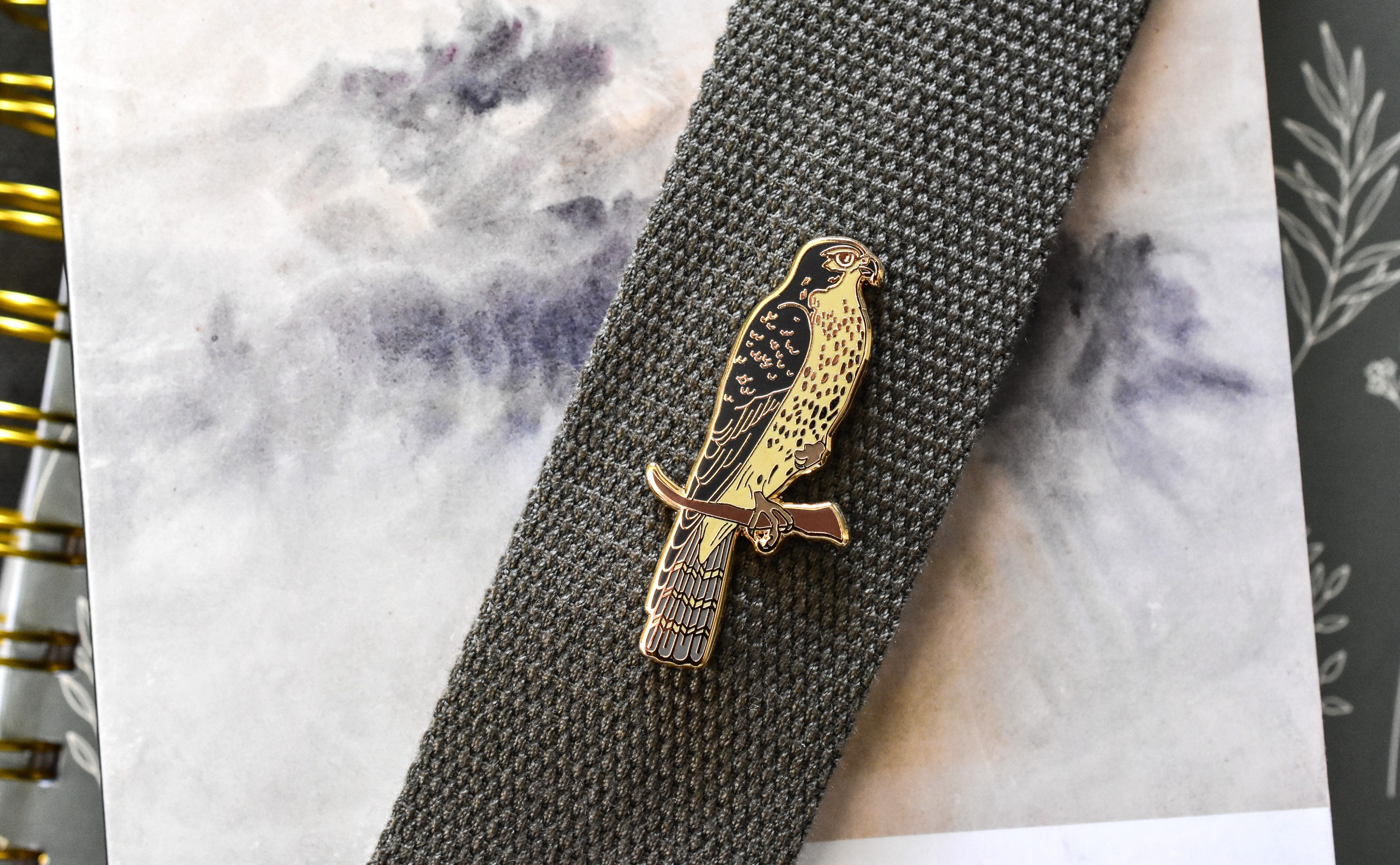
A few weeks ago I became acquainted with a UK-based Etsy shop called Thorn & Thunder. Olivia makes ‘inspired gifts for history and classic literature lovers!’
Honestly, I can’t recall who followed who on Instagram but we are now (according to the social media gods) friends. And, I’m so glad! This week I received a small padded envelope in my mailbox, postmarked with an image of King Charles. Inside, I found a wee portrait of Emily Jane made by Olivia and transformed into a sticker and…
I also discovered an absolutely stunning enamel pin depicting Emily Jane’s beloved rescued falcon, whom she called Nero. “This pin is a faithful representation of Nero,” reads the tag, “Emily Brontë’s rescued merlin falcon, as shown in a painting she made of him in 1841.”
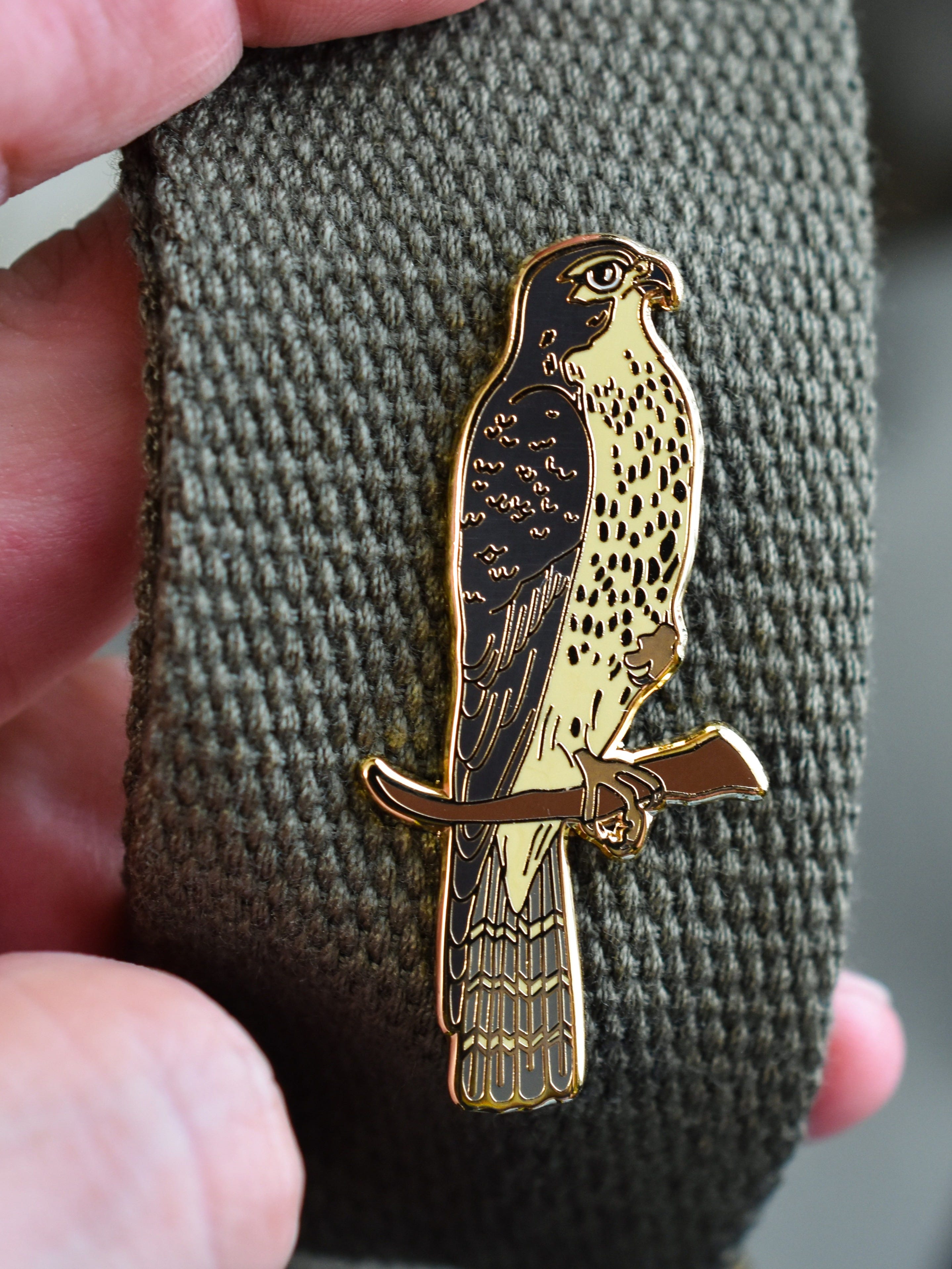
Do you know what drew me first to Olivia’s gorgeous pin? I’ll be honest: it was the fact that she knows merlins are falcons! You see, one of the common names for a merlin is pigeon-hawk; but Nero was a falcon, not a hawk.
Although I saw images of the enamel pin on Olivia’s IG and in her Etsy shop, I was not prepared for how truly beautiful the pin is in person. It is huge—measuring two inches from head to tail tip and 1/16th of an inch thick.
Two posts (with black rubber clutches) at Nero’s head and tail, hold the pin firmly in place when I attach it to the strap of my cross-body bag. I don’t doubt it will remain securely in place when I’m out-and-about and at the university library.
Olivia has also released an adorable enamel pin depicting Flossy, the beloved spaniel brought home to the Parsonage by Anne Brontë. Visit Olivia’s Instagram and Etsy to view all of her enamel pins (including a newly released Katherine Howard) and also, Tudor-inspired post card sets. (I’m lookin’ at you, Wolf Crawlers!).
Visit Thorn & Thunder and do support this small business in the UK!

About Emily Jane Brontë & Nero…
One story goes, Emily Jane Brontë rescued a merlin and named it Nero. Surprisingly, she caged it. We do not know the details, of course—because it wouldn’t be a story about Emily Jane Brontë if we had definitive details, would it?
This is what we do know:
On 27 October 1841 Emily Jane completed a painting of a merlin (Falco columbarius). It is said to be a study of her rescued pet, Nero. A number of biographers mention Nero (or Hero, as the merlin is sometimes called due to transcription error), but no one can pin down the details of Emily Jane’s procurement of the falcon.
Accounts exist of Nero being rescued on the moors as a fledgling. Others describe the raptor as having been injured—implying it was a grounded adult bird. Adult merlins are not birds to be retrieved without a scratch from a talon or a nip from a sharp beak.
Interestingly, though, in the Brontë family copy of Bewick’s A History of British Birds, adjacent to the engraving of a merlin, Emily Jane’s father Patrick wrote:
This bird has peculiarly great strength and vigour/pulling out the feathers of its tail, which I was obliged to do, with pincers, struck its talons, through a thick hair gloves [sic], which I wore, and brought the blood profusely out of my hand. P. B. 18411
Patrick, it seems, learnt how dangerous a merlin’s talons could be! So, was this bird Nero? Was the merlin moulting and Brontë believed it required human intervention? The note was written in 1841 and it certainly seems as though it would be the same bird Emily Jane refers to in her 30 July 1841 diary paper of the same year, in which she writes:
Victoria and Adelaide are ensconced in the peat-house – Keeper is in the kitchen – Nero in his cage –2
Victoria and Adelaide are geese. Keeper, of course, is Emily Jane’s beloved dog. And, Nero…is a merlin in a cage. By the time Emily Jane returns from her trip to Brussels, she laments:
...lost the hawk Nero, which, with the geese, was given away, and is doubtless dead, for when I came back from Brussels, I inquired on all hands and could hear nothing of him...3
Charlotte and Emily Jane had been away studying in Brussels, and by 1845, when they returned to the Parsonage, Victoria, Adelaide and Nero had all been ‘disappeared’ by (presumably) Aunt Branwell. None of this can really be proven nor disproven.
Although, if she raised a merlin she would have had to feed it something that would mirror its prey (whole birds, mice and large insects). Emily Jane willingly might have caught small birds and trapped mice but I doubt Aunt Branwell tolerated it for long!
Why did Emily Jane call Nero a hawk, you might wonder? Simple: Thomas Bewick’s A History of British Birds incorrectly refers to merlins as, “the smallest of the Hawk kind.” Honestly, I have no idea why Bewick got this wrong—Carl Linnaeus classified merlins as falcons way back in 1758. Another mystery surrounds Emily Jane Brontë and Nero…
Michael Stewart argues Nero may also have been misgendered; his claim is based on her watercolor painting of a merlin:
…Emily painted a female example of the species. As previously stated, only the female bird has bars on her tail, and the female has a dark brown back instead of the blue back of the male. Another important distinction is that the male is more distinctly moustachioed than the female.
If Emily’s painting is that of Nero, and verisimilitude suggests a close study from life rather than from a textbook, then Nero was probably female, despite the name suggesting otherwise.
Why then did Emily think Nero was male? There is a possibility that the bird Emily painted was a juvenile male. Juvenile males are ‘very similar to adult females’ and ‘generally not separable in the field’ (Svensson 2022, 1244). Most notably, the juvenile male shares some of the characteristics of the adult female, such as the striped tail and brown-grey back.
Was Nero a female merlin? Perhaps. Emily Jane referred to the raptor as he/him and she did not title her painting (so, we do not know if it literally depicts Nero, if it is a copy of the Berwick illustration or, did she use artistic license and create an original composition which combined elements of her pet, plus a female she had observed and included in it, a hint of the landscape she loved?) We’ll never know...
What delights me most about Emily Jane is the fact she took most of her secrets to her grave. It matters not to me if Nero was male or female, or how the author of Wuthering Heights procured the bird. The enamel pin I’ve recently added to my collection is quite lovely and faithfully represents the painting made in 1841—as far as I’m concerned, all other secrets may remain hidden. ♡
Stewart, Michael. "Emily’s Merlin: Brontëan Myths, the Decline of Raptors and the Diminished Ecology of Haworth Moor." Brontë Studies, vol. 50, no. 3, 2025, pp. 196-211, DOI:10.1080/14748932.2025.2501220.
Brontë, Emily. "Diary Paper, July 30, 1841." The Brontës' Web of Childhood, edited by Fannie Elizabeth Ratchford, Columbia University Press, 1941.
Brontë, Emily. “Diary Paper, 30 July 1845.” The Brontës’ Web of Childhood, edited by Fannie Elizabeth Ratchford, Columbia University Press, 1941.
Svensson, Lars. Collins Bird Guide. London: Collins, 2022.